

If you’re the kind of person who treats Anthropic’s flagship models like basic chatbots, you are leaving a lot of utility on the table. I’ve watched SEOs feed Claude 4.6 the exact same single-sentence instructions they used for ChatGPT a year ago, only to get predictably average outputs. The engine demands structure. It craves raw data. Above all, it requires explicit formatting boundaries.
The SEO industry relies heavily on automation. And yet, I constantly see practitioners using highly inefficient prompting techniques. They paste 5,000 words of competitor content into an interface, type “make this better,” and call it a day. That is not prompt engineering. That is hoping for a statistical miracle.
Here’s the catch: Claude 4.6 possesses a massive context window and a unique affinity for XML tagging. In my testing, this allows you to separate your core instructions from your background data, ensuring the model never hallucinates or loses the thread during complex technical audits. By formatting your inputs correctly, you can turn a generative model into a strict, analytical SEO assistant.
I put together this guide of 54 copy-paste Claude SEO prompts based on what actually works. I formatted each one in dedicated code blocks so you can copy them instantly without stripping the XML tags. We’ll cover everything from e-commerce scaling and aggressive content brief generation to technical site architecture.
Table of Contents
Why Claude 4.6 is the Best AI for Technical SEO
Search engine optimization often involves massive datasets. We are talking about crawl exports, log files, and keyword clustering sheets that span tens of thousands of rows.
Standard language models suffer from “lost in the middle” syndrome. If you upload a massive Screaming Frog export to them, they tend to analyze the first hundred rows, hallucinate the middle, and read the end. That’s where things get interesting with Claude 4.6; it minimizes this degradation. I tested this, and its recall accuracy remains incredibly high even when processing dense, unformatted CSV data.
It also refuses to insert unnecessary conversational filler if you explicitly tell it not to. For SEOs generating bulk meta descriptions or schema markup, this is critical. You definitely do not want a script failing because the AI enthusiastically decided to prefix your JSON-LD with “Here is the schema you asked for!”
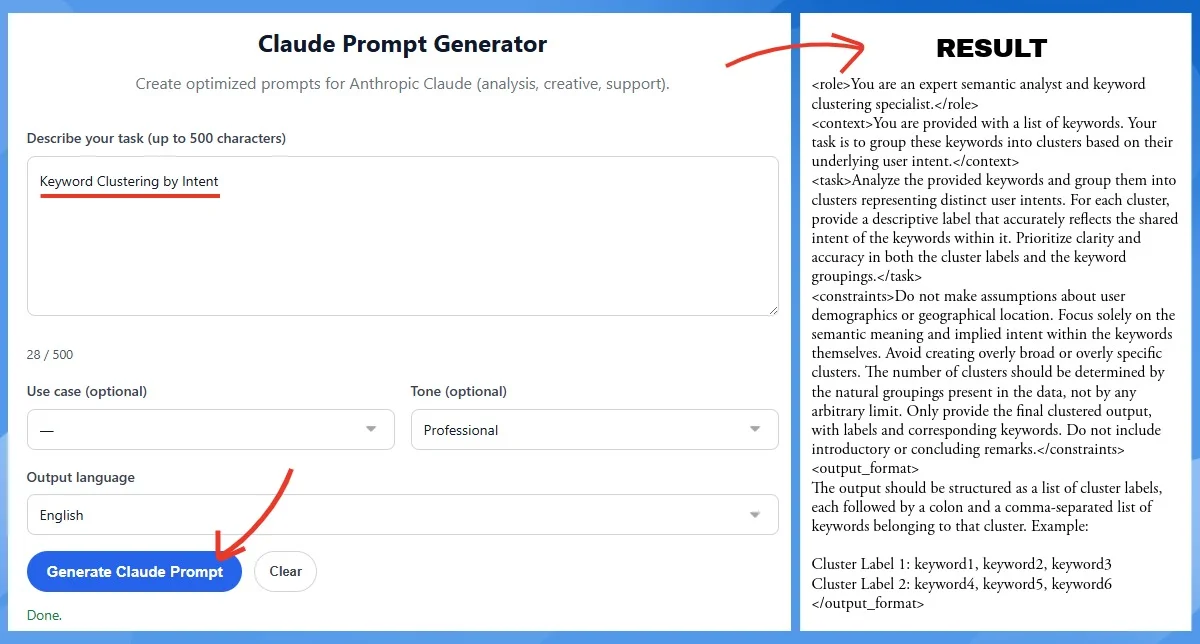
If you find yourself constantly adjusting syntax, running your raw ideas through a dedicated Free Claude Prompt Generator automatically structures your intent into the precise XML format the model actually prefers.
Using XML Tags to Structure Your Claude Prompts
XML tags are not just a preference. They are the cognitive scaffolding Claude uses to separate variables. When I write Claude SEO prompts, I always wrap distinct elements in specific brackets.
<role>establishes the persona.<context>provides background on the site or the client.<task>contains the strict operational verbs.<data>holds your pasted CSVs, keywords, or competitor text.<format_rules>enforces the output style.
By forcing the AI to read the prompt modularly, you eliminate conflicting instructions. If you want to compare how other models handle these strict parameters, testing the same prompt in a Google Gemini Prompt Generator reveals distinct differences in formatting adherence.
15 Prompts for E-commerce SEO Strategies
E-commerce sites live and die by architecture and taxonomy. I’ve seen a flat URL structure cause massive cannibalization, and poor faceted navigation create infinite crawl traps. You can use these prompts to untangle complex store architectures. Simply copy the code blocks below and replace the bracketed text with your own data.
1. Keyword Clustering by Intent
<role>Senior E-commerce SEO Strategist</role>
<task>Analyze the provided keyword list and cluster them into highly specific e-commerce category pages.</task>
<format_rules>Output a markdown table with: Cluster Name, Search Intent (Navigational/Commercial/Transactional), and Primary Keyword. Do not include any conversational filler.</format_rules>
<data>
[Paste Keyword List Here]
</data>
2. Faceted Navigation Rules
<context>I manage an e-commerce store with 10,000 SKUs using extensive filtering attributes.</context>
<task>Draft a strict robots.txt and canonical tag strategy to prevent crawl bloat from size, color, and price sorting parameters. Explain the exact logic for each rule.</task>
3. Bulk Title Tag Optimization
<task>Rewrite these product title tags to include the primary keyword near the front, a unique selling proposition, and keep them under 60 characters.</task>
<format_rules>Output only the numbered list of optimized titles. No explanations.</format_rules>
<data>
[Paste Current Titles Here]
</data>
4. Identifying Keyword Cannibalization
<task>Identify instances in this data where more than one URL is receiving impressions for the exact same query. Flag them as high-risk cannibalization and recommend which URL should be the primary canonical.</task>
<data>[Paste GSC export of URLs and Queries Here]
</data>
5. Product Description Expansion
<context>Our current manufacturer descriptions are thin and duplicate content.</context>
<task>Write a 300-word SEO-optimized description highlighting technical specs, practical use cases, and warranty details for the product below.</task>
<data>[Paste Product Name and Basic Specs Here]
</data>
For bulk scaling of this specific task, I found that feeding this logic into an AI Product Description Generator creates a completely automated content pipeline.
6. Category Page Intro Content
<task>Draft a 150-word introduction for an e-commerce category page targeting '[Target Keyword]'. Focus strictly on user value and internal link opportunities. Avoid generic fluff like 'Welcome to our store.'</task>7. Internal Linking Matrix
<task>Create a logical internal linking matrix for these categories. Identify which categories should link to each other based on semantic relevance to pass PageRank effectively.</task>
<data>
[Paste top 20 category URLs Here]
</data>
8. Out of Stock Handling SOP
<role>Technical SEO Lead</role>
<task>Define a specific Standard Operating Procedure (SOP) for handling products that go out of stock temporarily vs. permanently. Include exact HTTP status codes (301 vs 404 vs 410) and UX recommendations.</task>
9. Competitor Price & Value Comparison
<task>Analyze this competitor page text. Identify what trust signals, FAQ topics, and specific product specs they mention that we are currently missing from our template.</task>
<data>
[Paste competitor product page text Here]
</data>
10. Schema Markup for Products
<task>Generate valid Product JSON-LD schema for this item. Include AggregateRating, Offers (with price currency and item condition), and Brand fields. Provide only the raw JSON code block.</task>
<data>[Paste Product Data/Pricing Here]
</data>
11. Holiday Seasonal URL Strategy
<task>Explain how to structure Black Friday landing page URLs so they retain backlink equity year over year, rather than creating new URLs annually. Include redirect mapping examples.</task>12. Thin Content Detection & Action Plan
<task>Filter out all URLs with under 300 words from this list. Categorize them into 'Needs Expansion', 'Needs Noindex', or 'Needs Redirect' based on their URL slug context.</task>
<data>
[Paste Screaming Frog export with Word Count Here]
</data>
13. User Review SEO Extraction
<task>Extract the exact long-tail phrases, pain points, and descriptive adjectives customers use in these reviews. We will use these exact phrases in our next H2 tags.</task>
<data>[Paste 50 customer reviews Here]
</data>
14. Image Alt Text Generation
<task>Write descriptive, keyword-rich alt text for each image filename provided. Keep it under 125 characters. State exactly what the image shows without starting with 'image of'.</task>
<data>
[Paste List of image filenames or short descriptions Here]
</data>
15. Breadcrumb Logic Architecture
<task>Design an optimal breadcrumb hierarchy for an auto parts website. Ensure the hierarchy relies on exact logical parent-child relationships, and provide the accompanying BreadcrumbList schema.</task>14 Prompts for Technical SEO Audit Reports
Technical SEO audits require translating complex server responses into actionable steps a developer can actually execute. Claude excels at this translation layer. I regularly paste these directly to diagnose deep structural issues.
16. Log File Analysis Translation
<task>Identify Googlebot crawl frequency from this log snippet. Flag any 4xx or 5xx status codes Googlebot is hitting repeatedly. Provide a summary of wasted crawl budget.</task>
<data>[Paste snippet of server logs Here]
</data>
17. Core Web Vitals Diagnosis
<context>Our site's Largest Contentful Paint (LCP) is 4.5 seconds and Cumulative Layout Shift (CLS) is 0.8.</context>
<task>List the top 5 most common frontend development issues causing these exact metrics to fail. Write the step-by-step instructions for the dev team to fix them.</task>
18. Hreflang Tag Verification
<task>Check these hreflang tags for self-referencing errors, missing return tags, or incorrect language/region codes. Detail any critical failures.</task>
<data>
[Paste HTML head block Here]
</data>
19. Robots.txt Parser and Debugger
<task>Identify any directives in this robots.txt file that might accidentally block CSS, JS, or image rendering for Googlebot. Confirm if the sitemap declaration is formatted correctly.</task>
<data>
[Paste robots.txt content Here]
</data>
20. Redirect Chain Mapping
<task>Write the exact server-side rules (Apache or Nginx) to break this redirect chain and point all legacy URLs directly to the final destination URL via a single 301.</task>
<data>
[Paste list of URLs in a redirect chain Here]
</data>
21. Pagination Audit Strategy
<task>Review modern pagination best practices. Explain why using rel=prev/next is deprecated by Google, and outline the correct approach for handling paginated series to ensure deep crawlability without index bloat.</task>22. JavaScript Rendering Risks
<role>Technical SEO Specialist</role>
<task>Explain the SEO risks of client-side rendering (CSR) for dynamic content. Write a persuasive pitch to the engineering team advocating for dynamic rendering or Server-Side Rendering (SSR).</task>
23. Sitemap.xml Optimization
<task>Scan this sitemap snippet. Locate any non-200 OK URLs, orphaned pages, or duplicate entries. Suggest rules for automating future sitemap hygiene.</task>
<data>
[Paste snippet of sitemap.xml Here]
</data>
24. Site Migration Checklist Builder
<task>Generate a comprehensive, phase-by-phase technical SEO checklist for migrating a domain. Include DNS propagation, wildcard redirects, benchmark tracking, and URL mapping protocols.</task>25. URL Parameter Handling
<task>Analyze these query parameters (e.g., ?sessionid=, ?sort=price). Write explicit instructions on how to handle them via canonicalization to prevent massive duplicate content issues.</task>
<data>
[Paste list of parameterized URLs Here]
</data>
26. Header Tag Hierarchy Audit
<task>Identify skipped heading levels (e.g., H2 jumping directly to H4) in this document. Restructure the headings logically while maintaining the core keyword semantic flow.</task>
<data>
[Paste scraped H1-H6 tags of a page Here]
</data>
27. Analyzing Render-Blocking Resources
<task>Explain to a junior developer the difference between 'defer' and 'async' for JavaScript execution. Give examples of which scripts (like analytics vs. core DOM rendering) should use which attribute.</task>28. Canonical Tag Conflict Resolution
<task>Review this page's head. Determine if there is a conflict between the stated canonical tag, the Open Graph URL, and the actual requested URL. Explain how this confuses search engines.</task>
<data>[Paste HTML source code snippet Here]
</data>
29. HTTP Security Headers Check
<task>Evaluate these server response headers. Identify missing security protocols like HSTS, X-Content-Type-Options, or Content-Security-Policy that could impact enterprise SEO trust signals.</task>
<data>
[Paste server headers Here]
</data>
14 Prompts for Advanced Content Briefs
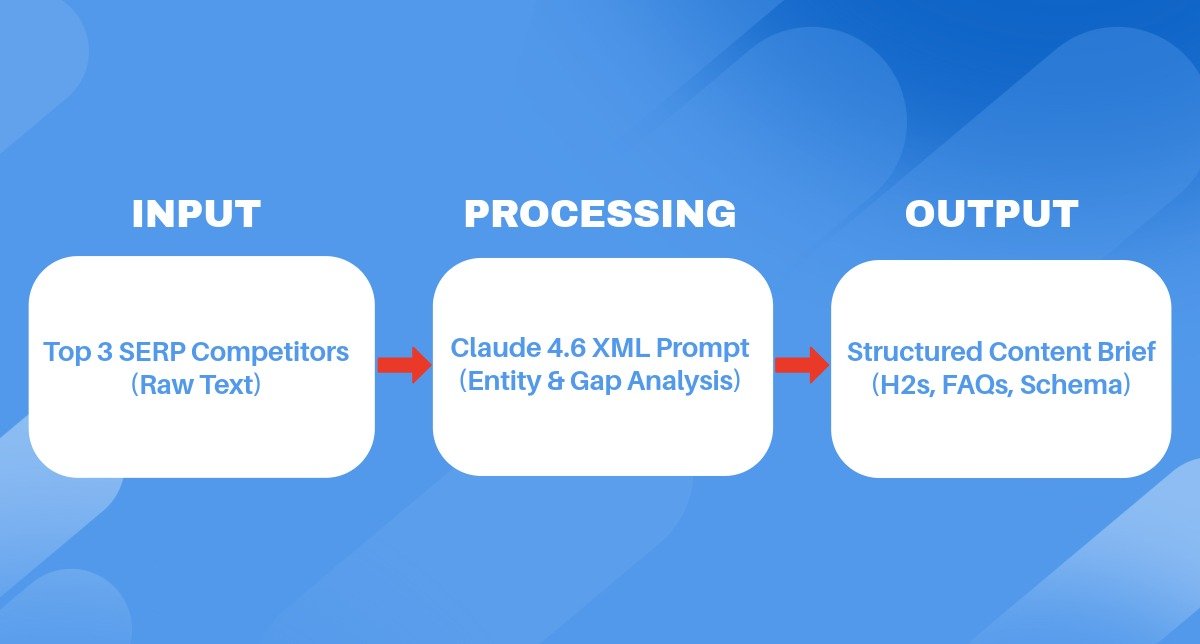
Generative text rarely ranks well on its own without proper structuring. The real power of Claude 4.6, from my experience, lies in its ability to synthesize top-ranking pages into highly detailed architectural briefs for human writers.
30. TF-IDF & Entity Extraction
<task>Extract all core NLP entities, specific industry jargon, and semantic keywords that these top-ranking competitors share. List them by frequency.</task>
<data>
[Paste text from top 3 ranking competitors Here]
</data>
31. Competitor Gap Analysis
<task>Identify specific subtopics, questions, or factual data points the competitor covers that my draft completely misses. Output a bulleted list of missing angles.</task>
<data>[Paste Competitor text]
---
[Paste My draft text]
</data>
32. Search Intent Mapping
<task>Analyze the keyword '[Target Keyword]'. Based on the phrasing, determine if the user wants a tutorial, a listicle, a tool, or an academic definition. Define the exact format the content must take to satisfy this intent.</task>33. Pillar Page Architecture
<task>Build a complete outline for a pillar page on '[Broad Topic]'. Include H2s for core concepts, and designate specific H3s that will act as internal links to smaller, long-tail cluster articles.</task>34. Featured Snippet Optimization
<task>Write a 45-word, highly objective, definition-style paragraph designed to win the 'What is [Concept]?' featured snippet. Do not use filler words. Be blunt and factual.</task>35. People Also Ask (PAA) Expansion
<task>Write concise, authoritative answers for each question provided. Structure the answers with a bolded direct response followed by a short bulleted list for readability.</task>
<data>
[Paste List of 5 PAA questions Here]
</data>
36. Authoritative Tone Calibration
<task>Rewrite this paragraph. Remove all passive voice. Remove phrases like 'It is important to note' or 'In today's fast-paced world.' Make it sound like an objective, senior industry expert writing for peers.</task>
<data>
[Paste draft text Here]
</data>
37. Statistics & Data Integration
<task>Review this draft. Identify three specific claims where a data point, statistic, or link to a primary source study would drastically increase the E-E-A-T (Experience, Expertise, Authoritativeness, Trustworthiness) of the article.</task>
<data>
[Paste draft text Here]
</data>
38. FAQ Schema Generation
<task>Take these 5 Q&A pairs and format them into perfectly valid JSON-LD FAQPage schema. Output strictly the raw JSON code block with no markdown formatting around it.</task>
<data>
[Paste Q&A pairs Here]
</data>
39. Content Refresh Strategy
<task>This article was written three years ago. Identify outdated concepts, suggest new H2s to bring it up to current standards, and explain exactly what sections to cut.</task>
<data>
[Paste old article text Here]
</data>
40. Video Script to Article Conversion
<task>Convert this messy, spoken transcript into a highly structured, SEO-optimized blog post outline with clear headings, bulleted takeaways, and optimized subheadings.</task>
<data>
[Paste YouTube transcript Here]
</data>
41. Click-Through Rate (CTR) Title Brainstorming
<task>Generate 10 headline variations for the keyword '[Target Keyword]'. Use emotional triggers, numbers, and brackets. Ensure the exact keyword remains intact. Limit each to 60 characters.</task>42. Semantic Topic Clusters
<task>Provide 15 semantically related topics to '[Core Subject]'. Group them into logical content silos: Beginner Concepts, Advanced Implementation, and Troubleshooting.</task>43. Internal Anchor Text Variations
<task>Generate 10 natural, descriptive anchor text variations for a page about '[Target Topic]'. Avoid exact-match over-optimization. Ensure they sound like natural parts of a sentence.</task>11 Prompts for Local & Industry-Specific SEO
Local SEO requires geographic relevance. Prompts in this category force Claude to think about spatial awareness, local intent, and specialized industry requirements. If you manage multiple niches, studying industry-specific AI prompts reveals exactly how to tailor tone and structure for distinctly different audiences.
44. Local Service Area Expansion
<task>Create a localized content outline for a service provider targeting '[City]'. Include H2s for neighborhood-specific landmarks, local building codes, and typical region-specific issues.</task>45. Google Business Profile (GBP) Posts
<task>Write three distinct GBP update posts (under 1500 characters). One educational, one promotional, and one highlighting a recent successful project in '[Neighborhood]'. Include a strong call to action.</task>46. Review Response Generator
<task>Write a professional, de-escalating response to this negative review. Acknowledge the issue, offer an offline resolution path, and discreetly insert a mention of our standard commitment to [Core Service].</task>
<data>
[Paste negative customer review Here]
</data>
47. Local Citation Audit Logic
<task>Explain the exact process for auditing NAP (Name, Address, Phone) consistency across Tier 1 data aggregators. Provide a checklist for finding and merging duplicate business listings.</task>48. Real Estate Property Listing SEO
<task>Write a property listing optimized for local search. Highlight transit scores, school districts, and specific architectural styles native to [City]. Naturally integrate the keyword 'homes for sale in[Neighborhood]'.</task>49. SaaS Feature Page Structure
<task>Draft a wireframe outline for a B2B SaaS feature page. Emphasize the 'Jobs to be Done' framework. Use H2s to address specific pain points rather than just listing technical software features.</task>50. Legal Practice Area Content
<task>Outline a practice area page for 'Personal Injury Lawyer in [City]'. Include sections strictly adhering to ethical advertising guidelines, avoiding guarantees of outcome, while building high trust and expertise.</task>51. Healthcare Location Pages
<task>Create a template for a hospital's clinic location page. Include necessary schema fields, accepted insurance formats, physician directories, and specific parking/transit instructions.</task>52. Restaurant Local Menu SEO
<task>Optimize this raw menu text into a structured HTML list format. Ensure dish names, dietary tags (vegan, gluten-free), and prices are clearly separated for local search parsing by Google.</task>
<data>
[Paste unstructured menu text Here]
</data>
53. Franchise Sub-domain Architecture
<role>Enterprise SEO Consultant</role>
<task>Explain the pros and cons of using sub-directories vs. sub-domains for a national franchise with 500 locations. Provide a recommendation based strictly on localized link-building potential.</task>
54. Hyper-Local Content Brainstorming
<task>Generate 5 blog post ideas for a local business in [City] that have nothing to do with their service, but focus entirely on community events, local partnerships, or local history to attract localized backlinks.</task>If you implement these prompts precisely, maintaining the XML structures I’ve shown, your workflows will accelerate drastically. Stop relying on basic chat interfaces and start building strict systems.
Frequently Asked Questions
I get asked a lot of questions about how this works in practice, so here are a few final thoughts on the process.
Does Claude 4.6 handle SEO tasks better than ChatGPT?
For technical tasks requiring strict adherence to formats like JSON or CSV, I’ve found Claude is generally superior due to its native understanding of XML prompt structures. It drops instructions far less often during long-context analysis.
What is the maximum context window for a Claude SEO prompt?
Claude 4.6 handles large context windows efficiently, allowing you to upload entire log files, large sitemaps, or extensive competitor content scraping directly into the prompt without losing those formatting constraints.
Can I use Claude to generate direct API code for SEO tools?
Yes. By explicitly setting the role to a developer and providing the API documentation in the context tags, I’ve had Claude successfully write Python or Node.js scripts to automate pulls from tools like Google Search Console or Ahrefs.
How do I stop Claude from writing robotic SEO content?
Command the model in the formatting instructions to avoid specific transition words, enforce varied sentence lengths, and forbid introductory paragraphs that simply define the topic. Strict negative constraints are absolutely necessary here.
Is it safe to paste client website log files into Claude?
Always anonymize sensitive client data. Make sure to remove specific user IP addresses or personally identifiable information from log files before parsing them through any third-party language model interface.
The Verdict
Claude 4.6 is a remarkably capable tool for technical SEO, but let’s be honest: it isn’t magic. It won’t fix a fundamentally broken website on its own, and you still need a human expert to verify its technical recommendations. To be fair, its understanding of log files is impressive, but you shouldn’t blindly push its code to a live server without a glance. That said, if you use the XML structures we’ve covered, it stops being a chatty novelty and becomes a rigorous analytical engine. As search engines continue to evolve, mastering this kind of structured prompt engineering will likely be what separates the actual strategists from the people just pressing ‘generate’.