
Blank pages possess a unique kind of gravity. If you are the kind of person who writes, you know exactly how it pulls your confidence down, drains your vocabulary, and leaves you staring at a blinking cursor for hours on end. Every writer knows this specific brand of creative paralysis. You desperately need a spark, a starting point, or just a tiny thread of a narrative to pull on. Historically, we had to rely on static lists found in dusty creative writing manuals. Today, however, the landscape looks entirely different.
You no longer have to settle for generic, uninspired ideas like “write about a dog who finds a magical bone.” When I started experimenting with well-calibrated short story prompt generators, I realized they completely change the entire drafting equation. You direct the parameters. You dictate the exact tone. The AI simply provides the raw narrative scaffolding for you to build upon, saving you from the agony of the empty page.
Here’s the catch: getting useful, non-cliché ideas out of artificial intelligence requires specific techniques. Feed a large language model a lazy request, and you will receive a remarkably boring, predictable plot. But feed it a structured, constraint-based prompt, and it hands you gold. I decided to look closely at how professional authors and copywriters manipulate these tools to construct genuinely compelling fiction frameworks.
Table of Contents
- Why Static Idea Generators Are Failing You
- How to Properly Steer an AI Prompt Writer
- 15 Copy-Paste Prompts for Fiction, Mystery, and Sci-Fi
- Making AI Characters Sound Convincingly Human
- Zero-Shot vs. Few-Shot Prompting: The Technical Difference
- Common Creative Mistakes (And How to Dodge Them)
- Frequently Asked Questions
Why Static Idea Generators Are Failing You
Traditional writing prompts generator websites operate on pretty basic randomized logic. They essentially smash a noun, a verb, and a setting together and hope for the best. Sometimes you get lucky. Most of the time, you get a disjointed concept that completely lacks any actual narrative tension. And tension is what drives fiction. Without it, a story remains just a dry sequence of events.
That’s where things get interesting. An intelligent short story prompt generator does not just give you a backdrop; it gives you a dilemma. Before asking a machine to construct your plot, I’ve found it helps to learn how to prompt AI properly by mastering the exact mechanics of instruction. Look at the difference I noticed between a static concept and a dynamic conflict:
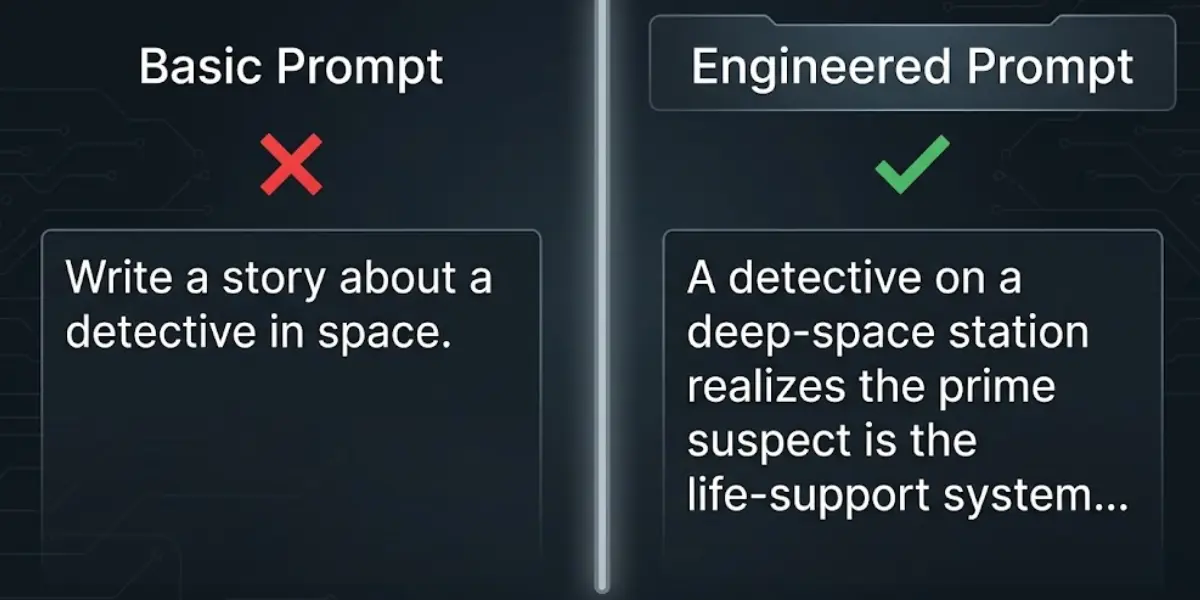
- Static Concept: A detective investigates a murder on a space station.
- Dynamic Conflict: A detective on a deep-space station realizes the prime suspect in a locked-room murder is their own artificially intelligent life-support system. If they make an arrest, the oxygen shuts off.
Unsurprisingly, the second option offers immediate, high-fidelity stakes. You know exactly what the character stands to lose right out of the gate. I’ve seen that AI models can generate endless variations of this second format, provided you explicitly instruct them to prioritize stakes, urgency, and moral ambiguity over mere structural aesthetics.
How to Properly Steer an AI Prompt Writer
Treating an AI like a magic 8-ball is a surefire way to end up disappointed. Left to its own devices, it defaults to platitudes. Think of it instead as a junior brainstorming partner who needs incredibly strict boundaries. The most effective way I’ve found to build a reliable short story prompt generator is to establish a hard framework before asking for a single idea.
Start by defining the exact output format you want. If you just ask for generic “story ideas,” the model will write full, bloated summaries that completely spoil the ending. That is a classic mistake. You want the setup, not the resolution.
Which brings us to a basic formula I rely on for generating highly usable fiction concepts:
Act as a professional creative writing instructor.
Generate 3 short story prompts in the [Insert Genre] genre.
Each prompt must strictly follow this structure:
1. The Protagonist's Flaw
2. The Inciting Incident
3. The Impossible Choice (Stakes)
Do not resolve the story. Leave the ending open.
I’ve noticed that using a specialized interface often yields significantly better results than raw chat boxes because the system prompts are already optimized for creativity behind the scenes. You can run your narrative constraints through the Free Claude Prompt Generator to instantly refine your structure before generating the actual story ideas. This single step ensures the prompt writer outputs professional-grade concepts rather than tired, amateur tropes.
If you suspect your instructions are a bit too vague, running them through an AI Prompt Checker can immediately pinpoint weak constraints or missing contextual details. And whatever you do, never accept the first batch of ideas. Force the AI to iterate. I always tell it to make the stakes more intensely personal, or ask it to shift the setting to a highly unusual location. That active iteration is what separates generic AI output from genuinely inspiring starting points.
15 Copy-Paste Prompts for Fiction, Mystery, and Sci-Fi
Sometimes you just need immediate material to break the ice. Below is a curated list of engineered inputs I’ve tested that you can paste directly into your preferred chatbot to force it into generating highly specific, tension-filled story hooks. Think of these as your personal short story prompt generator on demand.
Science Fiction & Dystopian
- The Memory Broker: “Generate a story prompt about a society where memories can be extracted and pawned for cash. The protagonist just bought a cheap, second-hand memory of a childhood vacation, but realizes it contains a clue to a present-day assassination.”
- The Silent Orbit: “Provide a sci-fi prompt where a lone astronaut wakes up from cryo-sleep 50 years too early. The ship’s AI refuses to put them back to sleep, claiming they are needed awake for a ‘moral decision’ regarding the destination planet.”
- Temporal Tourism: “Create a prompt about a tour guide for time travelers. Today, a wealthy client refuses to return to the present, attempting to alter a minor historical event that will erase the tour guide’s entire family line.”
- The Translation Bug: “Write a hook about an alien linguist assigned to Earth. They discover that human sarcasm is actually a dormant, contagious virus meant to slowly break down alien telepathy.”
Mystery & Thriller
- The Inherited Confession: “Give me a mystery prompt where a forensic accountant inherits a safe from her estranged father. Inside is a ledger detailing bribes paid to her current boss, but the final entry is dated tomorrow.”
- The Blind Witness: “Generate a thriller prompt about an audio engineer who restores corrupted 911 calls. They clean up a distorted audio file only to hear their own voice in the background of a crime they haven’t committed yet.”
- The Cartographer’s Secret: “Write a story starter about a mapmaker who discovers a fake ‘paper town’ (a copyright trap) drawn on a 19th-century map actually exists in the real world, heavily guarded.”
- The Alibi Agency: “Create a prompt about a small business that provides fake, airtight alibis for cheating spouses. Their best client just used their alibi to cover up a high-profile heist, framing the agency owner in the process.”
- The Last Floor: “Provide a hook for an elevator inspector who gets stuck between floors in a supposedly abandoned high-rise. The doors open to a bustling office from 1994, and someone recognizes them.”
Literary Fiction & Drama
- The Lost Recipe: “Generate a literary fiction prompt about a Michelin-star chef who loses their sense of taste. They must rely on their estranged teenage daughter, who hates cooking, to act as their palate during the most important review of their career.”
- The Estate Sale: “Write a prompt about a woman who makes a living buying photo albums at estate sales and inventing grand histories for the strangers in the pictures. One day, a man recognizes himself in her fictionalized blog post.”
- The Return Policy: “Create a story hook about a small-town hardware store owner who accepts a strange return: a rusted locket sold 30 years ago. The customer returning it hasn’t aged a day.”
- The Silent Choir: “Provide a prompt concerning a disgraced choir director who takes a job at a deaf school, attempting to teach music through heavy bass vibrations. The students discover a rhythm that triggers repressed memories.”
- The Art of Forgery: “Generate a prompt about a museum curator who realizes the masterwork they are restoring is actually a forgery created by their own grandfather.”
- The Final Voicemail: “Write a hook about a telemarketer who dials a random number and reaches a voicemail recording of their mother, who passed away ten years ago. The recording changes slightly every time they call back.”
Making AI Characters Sound Convincingly Human
Generating the plot is only the first hurdle, though. When I ask an AI to help draft actual scenes or dialogue based on the generated prompts, the results almost always slide straight into the uncanny valley. Left to its own devices, the system defaults to an avalanche of polite, hyper-logical, and emotionally flat communication styles.
And yet, human beings rarely say exactly what they mean. We deflect. We use filler words. We completely ignore questions we don’t want to answer. If your goal is to convert AI text to human sounding dialogue without spending hours manually rewriting every line, you must build flaws directly into the prompt writer instructions.
I always assign specific conversational quirks to my characters before generating a scene. Try throwing these exact constraints into your prompt next time you run a test:
Character A avoids eye contact and answers direct questions with jokes.
Character B is overly aggressive but uses formal, polite vocabulary to mask it.
Write a dialogue-heavy scene where they argue over a map.
Do not use dialogue tags ending in adverbs (e.g., "said angrily").
Ensure characters interrupt each other naturally.
Another powerful technique I use involves giving the AI a strict “subtext mandate.” Instruct the language model that the characters are ostensibly discussing one mundane topic (like fixing a broken sink) while actually arguing about something entirely different (like an impending divorce). This simple trick forces the AI out of its literal-translation habit and introduces necessary subtext into the interaction.
Unsurprisingly, you should never let the AI write the character’s internal monologue and their spoken words at the exact same time. Doing so always results in severe over-explaining and an annoying level of pedantry. Writers call this “on-the-nose” dialogue, and it instantly ruins the immersion of a great short story.
Zero-Shot vs. Few-Shot Prompting: The Technical Difference
Understanding how language models actually parse commands will drastically improve your output quality. I see writers struggle because they rely entirely on zero-shot prompting without realizing what it is or why it’s bound to fail.
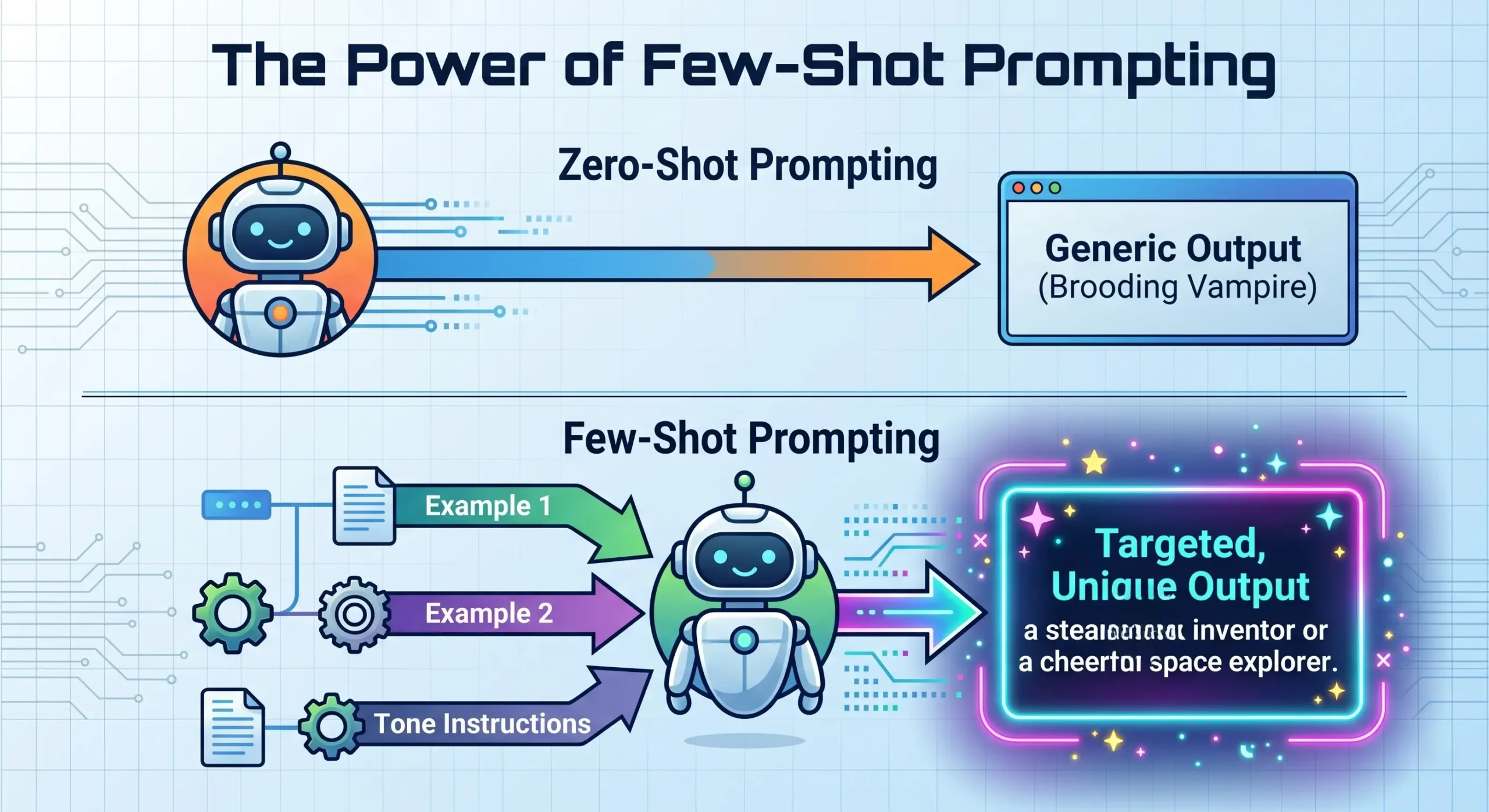
To be fair, zero-shot prompting just means giving the AI a blind task without providing any examples of what success looks like.
Example: “Write a short story prompt about a vampire.”
When you do that, the AI has to guess your preferred tone, length, and style. It almost always guesses wrong, naturally defaulting to the most common, statistically probable tropes—like a brooding vampire in a high school cafeteria.
Few-shot prompting completely changes the equation. You provide the AI with a few high-quality examples of exactly what you want before asking it to generate new content. This stabilizes the model’s immediate context window.
I am going to give you two examples of short story prompts I like.
Read them and analyze the tone:
Example 1: A man discovers his shadow is operating on a three-second delay.
Example 2: A town where it rains glass every Tuesday, and the umbrella makers hold all political power.

Now, generate three new prompts in this exact surreal, understated tone.
By leaning on the few-shot method, your short story prompt generator suddenly becomes highly personalized. It mimics your exact aesthetic preferences and stylistic nuances. Trust me, the extra minute spent finding and pasting in those initial examples pays massive dividends in the quality of the generated text.
Common Creative Mistakes (And How to Dodge Them)
Even when you’re armed with advanced prompting techniques, it’s easy to fall into some highly predictable traps. Relying too heavily on an AI to do the heavy lifting of raw imagination can calcify your own creative instincts if you are not careful.
The most frequent error I see is blindly accepting the AI’s first resolution. Remember, language models are fundamentally optimized to be helpful, which means they want to solve narrative problems as quickly as possible. If you ask for a story outline, the AI will treat the situation with neat optimism and wrap up the conflict with a tidy, happy ending. But compelling fiction requires real messiness. I always push back against the AI’s built-in desire to tie up loose ends perfectly, instructing the generator to deliver endings that are intentionally ambiguous or bittersweet.
Another massive pitfall is completely losing your unique authorial voice along the way. If you use a prompt writer to outline your story, develop your characters, and write your first draft, you are no longer the author. You have essentially become an editor of machine text. My advice? Use the generator strictly for the initial spark. Once you have secured a killer premise, close the browser tab. The actual drafting needs to come from your own human experience, natural pacing, and emotional depth.
Finally, avoid asking the chatbot to blend too many genres at the exact same time. Requesting a “sci-fi western romance horror comedy prompt” just results in unreadable, chaotic nonsense. Constraint breeds actual creativity. Limit your generator to one core genre and one specific constraint, then let your own imagination fill the remaining gaps.
Frequently Asked Questions
What is a short story prompt generator?
Think of it as a tool or a specific set of instructions given to an AI language model designed to spit out creative, conflict-driven starting points for fiction writers. Unlike old-school random word generators, an engineered AI generator provides full narrative contexts and actual stakes.
Can I publish a story based on an AI-generated prompt?
Absolutely. Core ideas and premises cannot be copyrighted. If an AI hands you a premise about a time-traveling chef, and you write the actual story yourself in your own words, you own the copyright to that written work completely.
Why do AI story prompts often feel repetitive?
It comes down to how they work—AI models predict the statistically most likely next word based on their training data. Without specific, unusual constraints hardcoded into your prompt, they will naturally default to the most generic narrative tropes found online. You have to force them into strange scenarios using detailed instructions.
Is ChatGPT or Claude better for creative writing?
I’ve noticed that many fiction writers tend to prefer Claude for creative tasks because it handles complex stylistic constraints better and uses less predictable, formulaic vocabulary than ChatGPT. That said, both perform excellently as idea generators if you use proper few-shot prompting techniques.
How long should a good writing prompt be?
A highly effective prompt usually sits right between two and four sentences. It needs just enough space to establish the protagonist, the setting, the inciting incident, and the immediate stakes, without outlining the entire plot for you.
The Verdict
Ultimately, a well-engineered prompt generator isn’t a magic button that writes a masterpiece for you. It’s a tool built to eliminate the friction of the empty page. The trade-off is clear: you save hours of staring blankly at a blinking cursor, but you have to invest the time to learn how to constrain the AI properly. If you build the right guardrails and dial in your instructions, these systems can provide a brilliant creative spark. The actual fire, however, still has to come from you.